WP0
Project management
Lead: C. Lartizien, J. Jung
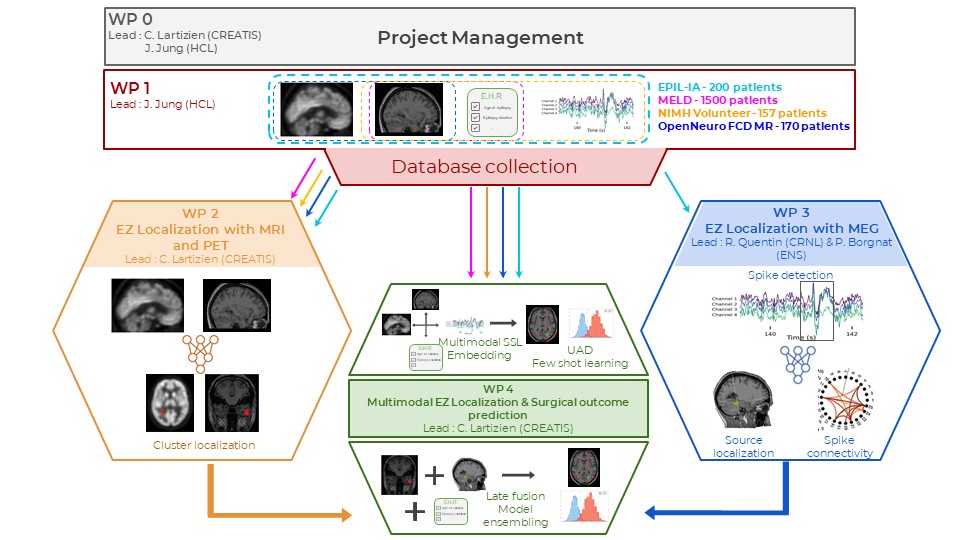
Coordinate the consortium and the shared multimodal database.
What SEIZURE does
Fusing structural, metabolic and electrophysiological brain data with machine learning to find the epileptogenic zone and predict surgical outcome.
Work packages
Coordinate the consortium and the shared multimodal database.
Assemble a curated multimodal cohort of more than 200 patients across MRI, PET, MEG and clinical data.
Detect and phenotype subtle epileptogenic lesions from structural and metabolic imaging.
Detect interictal spikes and map spike propagation with graph signal processing.
Fuse the modalities to localize the EZ and predict surgical outcome.
The challenge
Epilepsy resists drug treatment in roughly 30% of patients. For them, surgically removing the epileptogenic zone (EZ) is the best option, yet no single biomarker pinpoints it and predicting surgical outcome stays hard.
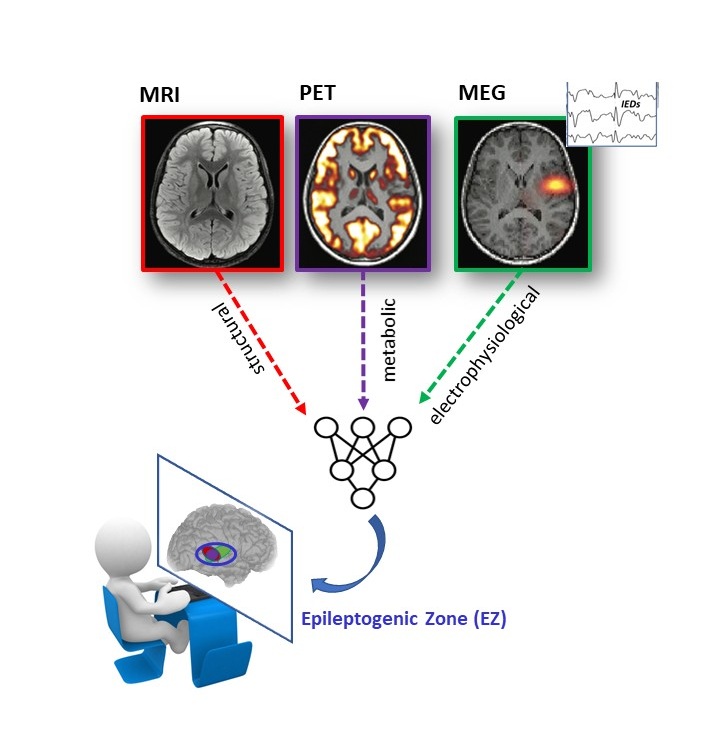
MRI and PET expose subtle structural and metabolic lesions, while MEG records the brief electrophysiological events that travel through the epileptic network. These anatomical and functional views have largely evolved in parallel, and epileptologists still combine them by hand.
Our approach
SEIZURE builds a statistical analysis framework that fuses multiparametric MRI, PET, MEG and clinical data to localize the EZ and predict surgical outcome. It draws on advanced machine learning for image and graph signal processing and for combining heterogeneous data.
Our hypothesis is that this integrated, transdisciplinary approach can deliver a step change in diagnostic performance, built on a multimodal database of more than 200 patients already collected by the clinical partner.
Timeline
Partners
A transdisciplinary consortium across imaging, neuroscience, clinical epileptology and signal processing.